

Long exposure photography is one of those things that seems straightforward until you try it with film.
You set up your camera, meter the scene, and your light meter tells you that the exposure should be 30 seconds. Easy enough. You put the camera into bulb mode, expose the film for exactly 30 seconds and move on.
Then you develop the film.
The negative is underexposed.
Your meter was correct. Your shutter timing was correct. Your aperture was correct. So what happened?
The answer is something called reciprocity failure.
Despite the slightly intimidating name, the idea behind it is actually quite simple.
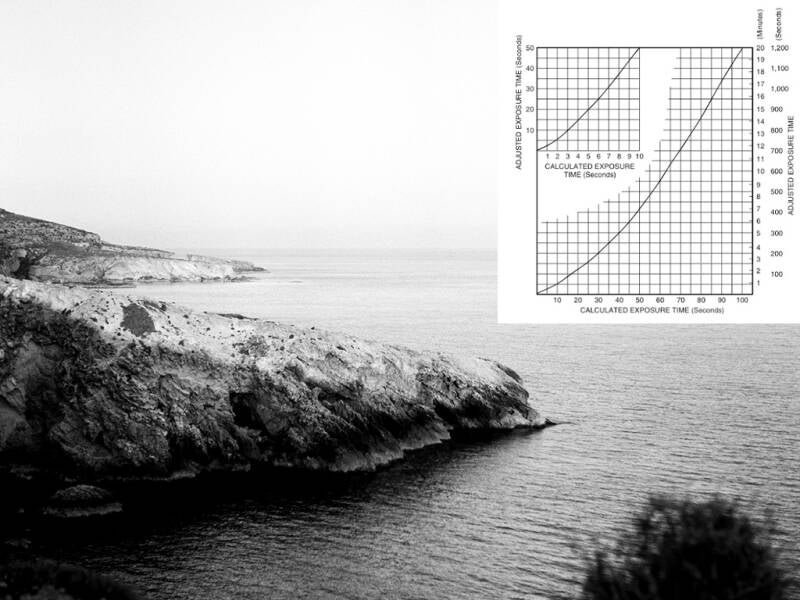
First, What Is Reciprocity?
Photography normally follows something called the reciprocity law. All this really means is that exposure is a relationship between the amount of light reaching the film and the amount of time the film is exposed to that light.
Imagine your correct exposure is:
f/8 at 1 second
If you close the aperture by one stop to f/11, you are letting half as much light through the lens. To compensate, you simply expose the film for twice as long:
f/11 at 2 seconds
Close down another stop:
f/16 at 4 seconds
Each time we reduce the amount of light, we increase the amount of time. Theoretically, the resulting exposure should remain the same.
And during normal photography, this works extremely well. The problem begins when our exposures become very long.
When Reciprocity Starts to Fail
Film does not respond to light perfectly.
At very low light levels, the relationship between light and time begins to break down. The film effectively becomes less efficient at recording the light hitting it. This is reciprocity failure. So imagine your light meter calculates an exposure of: 30 seconds
You might assume that exposing your film for 30 seconds will produce the correct exposure. But the film may actually need significantly longer than that. The important thing to understand is that your light meter hasn't suddenly become inaccurate. It has correctly calculated how much light should theoretically be required.
What it doesn't know is how efficiently your particular film can record that light over a long period of time. That is why we need reciprocity compensation.
A Real Example: Ilford HP5 Plus
Let's use one of the lab’s favourite films as an example: Ilford HP5 Plus. Ilford publishes reciprocity information for its films and gives HP5 Plus a compensation factor of 1.31.
The formula is: Corrected Exposure = Metered Exposure x 1.31
You certainly don't need to memorise that formula, but it helps us see what is actually happening. Let's say your meter gives you an exposure of: 10 seconds
If reciprocity didn't fail, we would simply expose HP5 for 10 seconds. But once we apply Ilford's correction:
10 x 1.31 = approximately 20 seconds
Your 10-second exposure has suddenly become a 20-second exposure. and the longer your exposure gets, the more noticeable the difference becomes.
Metered Exposure
1 second
2 seconds
5 seconds
10 seconds
30 seconds
1 minute
2 minutes
Approx. HP5+ Corrected Exposure
1 second
2.5 seconds
8 seconds
20 seconds
86 seconds
3 min 34 sec
8 min 50 sec
So imagine photographing a scene where your meter recommends a two-minute exposure. You expose the film for two minutes and expect a correctly exposed negative. In reality, HP5 Plus may need nearly nine minutes. That is a huge difference.
Ilford states that exposures of one second or less do not require compensation under its current reciprocity guidance. It also warns that extremely long exposures can introduce other variables, so manufacturer figures should be treated as a very good starting point rather than an absolute guarantee.
Why Does Film Do This?
Without getting too deep into photographic chemistry, film contains light-sensitive silver halide crystals. When photons strike these crystals, they begin forming what will eventually become the image when the film is developed. Under normal lighting conditions, this happens efficiently. During very long exposures, however, the light reaching the film can be extremely weak. Ilford describes reciprocity failure as a reduction in the efficiency with which stable development centres are formed at these low light levels.
In much simpler terms:
Film becomes less efficient at recording extremely small amounts of light over long periods of time. Giving the film twice as much time therefore doesn't necessarily give you twice as much photographic effect. Eventually, you have to give it even more time to compensate.
Every Film Is Different
This is probably the most important practical part of reciprocity failure. There is no universal reciprocity correction.
You cannot learn one rule and apply it to every film you shoot. Even films made by the same manufacturer behave differently. Ilford currently gives HP5 Plus a factor of 1.31, FP4 Plus 1.26, Delta 100 1.26 and Delta 400 1.41.
That means two cameras sitting next to each other, photographing exactly the same scene with different films, may eventually require different exposure times. Some films are particularly good at dealing with long exposures. Fujifilm Neopan Acros II, for example, is specifically marketed as having excellent reciprocity characteristics and being suitable for long-exposure photography. This is why you should always check the manufacturer's technical data for the specific film stock you are using.
Don't just search for a generic "film reciprocity chart" and assume it applies to everything.
Reciprocity Failure Can Also Affect Contrast
There is another side to reciprocity failure that is easy to overlook. It isn't necessarily the equivalent of simply underexposing the entire photograph evenly.
Think about a night photograph. Your streetlights might be extremely bright while the shadows underneath buildings are receiving tiny amounts of light. Those darker areas can experience reciprocity failure differently from the highlights.
As a result, very long exposures can produce an increase in contrast. Ilford specifically warns about this and notes that reduced development may sometimes be useful when it becomes excessive.
This is also why the solution isn't simply: "I'll underexpose it and brighten the scan later."
Look at the technical information for the exact film you're shooting.If shadow information was never properly recorded onto the negative, your scanner cannot magically recreate it. A good scan starts with a good negative.
What About Colour Film?
Things can become even more interesting with colour film. Black-and-white film is essentially concerned with recording different levels of light as density. Colour film has multiple light-sensitive layers responding to different parts of the visible spectrum. During extremely long exposures, these layers may not necessarily experience reciprocity failure in exactly the same way. The result can therefore be more than simple underexposure. You may also experience colour shifts. Depending on the film, manufacturers may recommend additional exposure, colour-correction filters, or both for long exposures. So when shooting long exposures on colour film, checking the manufacturer's technical sheet becomes particularly important.
How I Would Actually Shoot a Long Exposure
Despite everything we've just discussed, shooting long exposures on film doesn't need to be complicated.
Our process is:
- Meter the scene normally. (and always taking 2 meterings, a general one and a subject focused one)
- Check whether reciprocity compensation is required.
- Calculate the corrected exposure. (Use the manufacturer's chart, formula or recommended correction.)
- Set the camera to Bulb or Time mode if necessary. (Once exposures become longer than your camera's normal shutter speeds, you'll need to control the shutter manually.)
- Use a tripod and cable release. (At these exposure times, even tiny camera movements can ruin the photograph)
- Expose for the corrected time, not simply the metered time. (If your meter says 30 seconds but your film requires 86 seconds, expose for roughly 86 seconds.)
- And if the photograph is particularly important, bracket your exposures.
- Develop our film at DarkLab 😉: (With Our B&W Dev, Pull & Push &Colour Dev services you'll get the best out of your beautiful long exposure film!)
Film, lighting conditions and extremely long exposure measurements can introduce enough variables that giving yourself another negative is often worth it.
The Easy Way to Remember It
If you remember nothing else from this article, remember this: When exposures become very long, film needs more light than your meter thinks it does.
Your meter might say: 10 seconds.
Your film might say: Give me 20.
Your meter might say: 2 minutes.
Your film might say: I'll need nearly nine.
That difference is reciprocity failure. And the amount of additional exposure you give the film is reciprocity compensation. Once you understand those two ideas, the intimidating name becomes a surprisingly simple concept.
So the next time you're standing next to your camera at night, stopwatch in hand, wondering why a two-minute exposure has somehow turned into nine minutes, you'll know exactly what your film is doing. It's not your light meter getting confused.
It's just film being film.
Add comment
Comments