

If you have spent any time around film photographers, you have probably heard someone mention pushing or pulling a roll. It sounds technical, maybe even a bit intimidating, but the idea behind it is straightforward once you strip away the jargon. This is our attempt to explain it plainly, without the usual wall of darkroom terminology.
What pushing actually means
Pushing a film means shooting it as though it is more sensitive to light than it actually is, then asking the lab to develop it for longer to compensate. Say you are shooting Ilford HP5 Plus, which is rated at ISO 400. If you set your camera to ISO 1600 and shoot the whole roll that way, you have pushed it two stops. The film itself has not changed. What changes is how long it sits in the developer afterwards.
The reason people do this is almost always light. You are somewhere dim, your shutter speed is dropping too low to keep things sharp, and you do not have a faster film stock on you. Pushing lets you keep shooting in conditions the film was not really built for.
What pulling actually means
Pulling is the opposite. You shoot the film as though it is less sensitive than its rating, then the lab develops it for less time. This is rarer, but it has its uses too, usually when someone has shot in very bright, contrasty light and wants to soften the result, or when a roll was accidentally shot at the wrong setting and needs correcting after the fact.
Why it is not just a technical fix
What pushing and pulling actually do is change the character of the image, not just brighten or darken it. Pushed film tends to gain contrast and grain. Shadows get deeper, blacks get blacker, and the overall look becomes grittier. Pulled film does the reverse, flattening contrast and softening the image slightly. Neither is a corrective measure in the way adjusting exposure on a digital camera would be. It is closer to choosing a different mood for the same roll of film.
This is why some photographers push film on purpose even when they have enough light. It is a creative choice as much as a technical one.
A real example from our darkroom
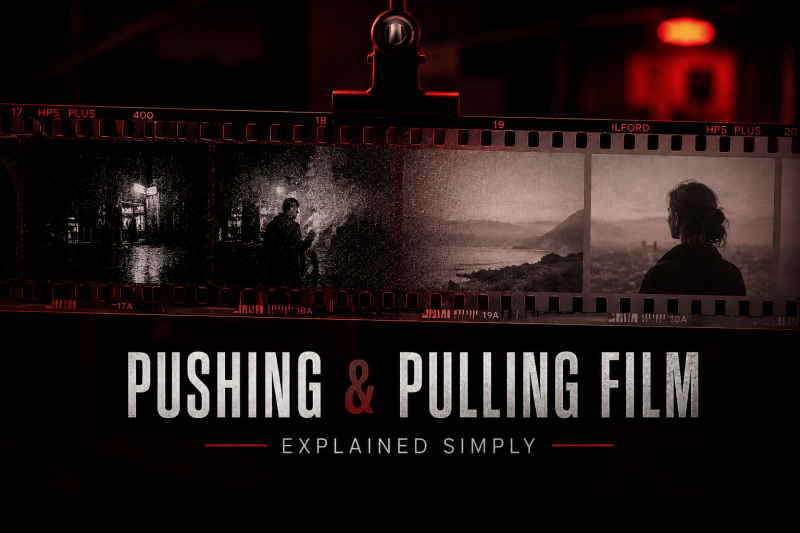
We have pushed Ilford HP5 Plus to ISO 3200 here, three full stops past its rating, using HC-110 at Dilution H with a semi stand development process. The grain becomes much more pronounced, contrast climbs noticeably, and the overall feel shifts from the clean, flexible look HP5 Plus normally has into something closer to classic grainy reportage. It is not subtle, and that is rather the point.
We mention this because the difference between reading about pushing and seeing what three stops actually does to an image is significant. If you are considering it, it helps to know roughly what you are walking into before you commit a whole roll.
A couple of things worth knowing before you try this
HP5 Plus handling three stops well does not mean every stock will. Latitude (which is the range of exposure film can capture without loosing details in the shadows or highlights) varies a great deal from one stock to another. Some films start losing shadow detail or shifting colour badly after just one or two stops. Others, like HP5 Plus, are known for tolerating a heavier push. As a rough guide, anything beyond two stops is worth treating as an experiment rather than a sure thing, even if you have read about someone else having success with it on a different stock.
The other thing to know is timing. The decision to push or pull has to be made before you load the film and start shooting, not partway through the roll. This is because development happens to the whole roll at once, in one tank, for one length of time. If half your frames were shot at box speed and the other half at a pushed speed, there is no way to develop those two halves differently once they are on the same roll. The only real exception is film specifically designed to have its speed changed mid roll, which is unusual and not something most photographers will encounter. For anything else, decide your rating before you load the camera, shoot the entire roll at that rating, and let us know what you shot at when you hand it in.
How to know if you need it
If you are shooting and the light is forcing you to slow down past what feels comfortable, or you are simply curious what a stock looks like with more grain and contrast, pushing might be worth trying. If you have shot somewhere very bright and contrasty and want a gentler result, pulling is the one to consider. Either way, the most important thing is communicating it clearly when you hand the roll in. Development time has to match what you actually shot at, not what is printed on the canister, or the results will not come out as intended.
How we handle it at DarkLab
We offer push and pull processing as part of our standard development service. If you know in advance that you have shot a roll at a different speed, just let us know when you drop it off or order online, and we will adjust the development time to match. It does carry a small additional cost over standard development, and as with any non standard process, results can vary slightly from roll to roll depending on the stock and the degree of push or pull involved.
If you are shooting a roll soon and thinking about trying this for the first time, it is worth experimenting with a stock you already know well. That way, any change you see in the final images is down to the push or pull itself, not an unfamiliar film stock at the same time.
-
NEW

-
NEW

-
SOLD OUT


Add comment
Comments